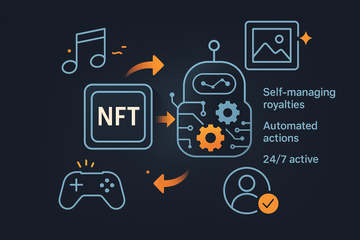
Imagine an NFT that does not just sit in your wallet. It watches, reacts, and sometimes moves first. That is the basic idea behind an autonomous NFT, or aNFT. It is a non-fungible token with code that can initiate its own transactions without someone clicking confirm every time. Sounds a bit sci-fi, right? You know what, it is closer to normal than it seems.
So, what makes an NFT autonomous?
An aNFT is still an ERC-721 or ERC-1155 at the surface. The difference lives under the hood. The token connects to logic that can trigger actions, like sending a tip, rotating a royalty split, staking rewards, or updating a listing. The “self” part comes from smart contracts and a few building blocks that help it act without a human.
- Account abstraction, ERC-4337. Instead of a simple externally owned account, a smart account can bundle rules, pay gas in different tokens, and use a sponsor called a paymaster.
- Token Bound Accounts, ERC-6551. The NFT holds its own wallet. The token is the key to a smart account that can own assets, sign actions, and record history.
- Automation networks. Services like Chainlink Automation, Gelato, and OpenZeppelin Defender can call your contract when conditions are met.
- Oracles and events. The aNFT can listen for price moves, on-chain events, or time windows, then act.
Put together, an aNFT looks like a small on-chain agent. Not a person, not a bot in your browser, but code with a schedule and clear permissions.
Why this matters for collectors and creators
People buy NFTs for many reasons, from art to access to gaming. Autonomy adds another layer. It reduces repetitive tasks, shares revenue on cue, and keeps experiences lively even when you are asleep. Here are a few use cases that already feel practical.
- Self-managing royalties. An aNFT can split royalties across collaborators the moment a resale hits, without a manual sweep.
- Active art and music. Generative pieces can evolve with time or price triggers. A song pass can route micro-royalties daily instead of monthly.
- Game items that play. Think of a companion that auto-claims rewards, re-equips gear, or rents itself when idle.
- Memberships and brand passes. A pass that renews, checks in, and tracks perks on its own helps fans and brands stay synced.
- Rentals and trials. With ERC-4907 style rentals, aNFTs can list, unlist, and settle fees without friction.
There is a small contradiction here. People collect for ownership and control, yet they want less work. Autonomy bridges that gap. You keep the asset, while the boring parts handle themselves.
How an aNFT actually sends a transaction
Let me explain with a simple flow. Say you hold an aNFT tied to a musician’s project. The token sits inside an ERC-6551 account. When a resale hits a marketplace, a royalty event fires. That event calls a contract function that calculates the split for the band, the mixer, and the visual artist. An automation service checks the block every few minutes, sees the event, and calls the payout function. The aNFT’s account signs through predefined rules, and a paymaster covers gas in stablecoins. Funds reach the right addresses, and the ledger reflects it, no late-night spreadsheets needed.
Another example. A gaming aNFT has a stamina meter. If stamina drops below a threshold, the aNFT stakes a potion token it already holds, recovers, and logs the action in its history. No pop-up. No human. Just rules.
That is the heartbeat of autonomy, a small checklist, consistent triggers, and a safe way to pay fees.
Under the hood, the key components
Smart accounts and session keys
With ERC-4337, you can define what an account is allowed to do. You can create session keys with limited scope, for example a game session that only calls two contract methods for three hours. This keeps the aNFT moving while limiting risk.
Paymasters and gas tanks
Some aNFTs keep a small gas balance, sometimes in a stablecoin, and rely on a paymaster to convert and sponsor fees. Services like Biconomy or Stackup help here. A simple top-up rule, say keep 0.002 ETH equivalent on hand, prevents stuck actions during busy times.
Automation services
Chainlink Automation, Gelato Web3 Functions, and OpenZeppelin Defender AutoTasks act as reliable robots. They watch, they call, they record. You do not need a laptop open or a cron job on a VPS. The schedule lives on the network.
Oracles and data checks
Price feeds, time triggers, and custom signals give aNFTs something to react to. Keep data simple, and verify on-chain when you can. Less confusion, fewer surprises.
Security first, because the stakes are real
Autonomy is cool, but security makes it useful. A few patterns go a long way.
- Guard rails in code. Add rate limits, pause switches, and allowlists. A subtle cap on daily sends can save a bad day.
- Multisig and timelocks. Put admin powers behind a Safe multisig with a timelock. Urgent fixes can still move, but nothing sneaks by.
- Separate funds. Isolate the aNFT’s gas tank from larger treasuries. If something misbehaves, the blast radius stays small.
- Audits and monitoring. Use OpenZeppelin tools, Slither, and formal checks where it matters. Add alerts for unusual patterns.
And for humans signing the important keys, use a hardware wallet. A Ledger or a Trezor keeps deployer and guardian keys out of reach of common malware. Store the seed offline, consider a passphrase, and keep recovery written on paper or metal. It sounds fussy, but it turns scary moments into non-events.
What could go wrong, and how to plan for it
Let us be honest. Automation can fail. Oracles can lag. Gas spikes can freeze a queue. Front-running and MEV can mess with time-sensitive actions. So plan for it.
- Graceful degradation. If a trigger misses, retry with backoff. If funds are low, pause noncritical actions first.
- Replay protection. Use nonces and replay guards on signatures.
- MEV awareness. Bundle when possible, or use private relay options for sensitive calls.
- Clear stop button. A guardian should be able to pause the aNFT’s active features within a set window.
There is also the social side. Who is liable if an aNFT acts badly, or just weirdly? That is not legal advice, but transparency helps. Public rules, visible limits, and a short policy note calm nerves for buyers and partners.
Wallet UX, without the forehead-scrunch
People should not need a diagram to use aNFTs. A good pattern is simple default behavior, with an advanced panel for nerds. Make the first run delightful. Show what the aNFT can do, show how to turn things off, and show where the gas sits. If a mobile wallet connects, use signless sessions for low risk actions, and require a clear confirm for anything bigger.
For collectors using hardware wallets like Ledger or Trezor, pair them with a smart account so day-to-day actions run safely, while the hardware wallet protects the master key. It feels calm. That calm is the real feature.
Tools to build and test an aNFT
You do not need a giant stack to try this. Start small, ship gradually, and keep logs.
- Contracts. Hardhat or Foundry for development. OpenZeppelin templates for ERC-721 and access control.
- Smart accounts. Safe, Kernel, or an ERC-4337 toolkit from Alchemy, Stackup, or Biconomy.
- Automation. Chainlink Automation, Gelato, or OpenZeppelin Defender.
- Testing. Anvil, Tenderly for simulation, and fork tests for nasty edge cases.
- Monitoring. Tenderly Alerts, Etherscan watchlists, and simple Grafana dashboards.
Run on a testnet, hit it with odd inputs, and write down what happens. Mild repetition here is good. Test, adjust, test again.
Where aNFTs fit in the market right now
Collectors like novelty, but they keep what feels useful. aNFTs shine where time and money flow in small repeated actions. Music projects, loyalty passes, and game items have a strong fit. High-end art can benefit too, since a piece that changes on a public schedule stays interesting and honest. Brands seem curious, since a self-updating pass keeps perks fresh with less overhead.
We are also seeing a soft merge with AI agents. An off-chain model can suggest actions, while the on-chain aNFT confirms or rejects based on strict rules. Keep the boundary tight. The AI does not hold the keys. It only proposes. The aNFT signs within limits.
A quick checklist before you hit mint
- Define what your aNFT should do, and what it must never do.
- Pick one reliable trigger, not five. Add more later.
- Set a small gas tank with alerts. Top up automatically if you want, but cap the monthly spend.
- Guard the admin with a Safe multisig, and keep the keys on a Ledger or a Trezor.
- Publish docs with rules and limits. People appreciate clarity.
Final thoughts, with a steady pulse
Autonomy does not mean chaos. It means decisions that you predefine, executed with care. The fun part is watching an asset behave like a tiny brand, a tiny bandmate, or a tiny pet that knows when to act. The serious part is making it safe, legible, and respectful of your time.
Honestly, that mix is what makes aNFTs feel compelling. A little magic, a lot of structure, and a practical path from idea to working code. If you are a creator, a collector, or a wallet nerd who enjoys elegant systems, this is a good moment to try one small autonomous feature. Just one. See it run, learn a bit, then add another. Slowly. Surely.
Because when your NFT can act with care, you work less and get more out of it. That is not hype, that is just a better rhythm.


